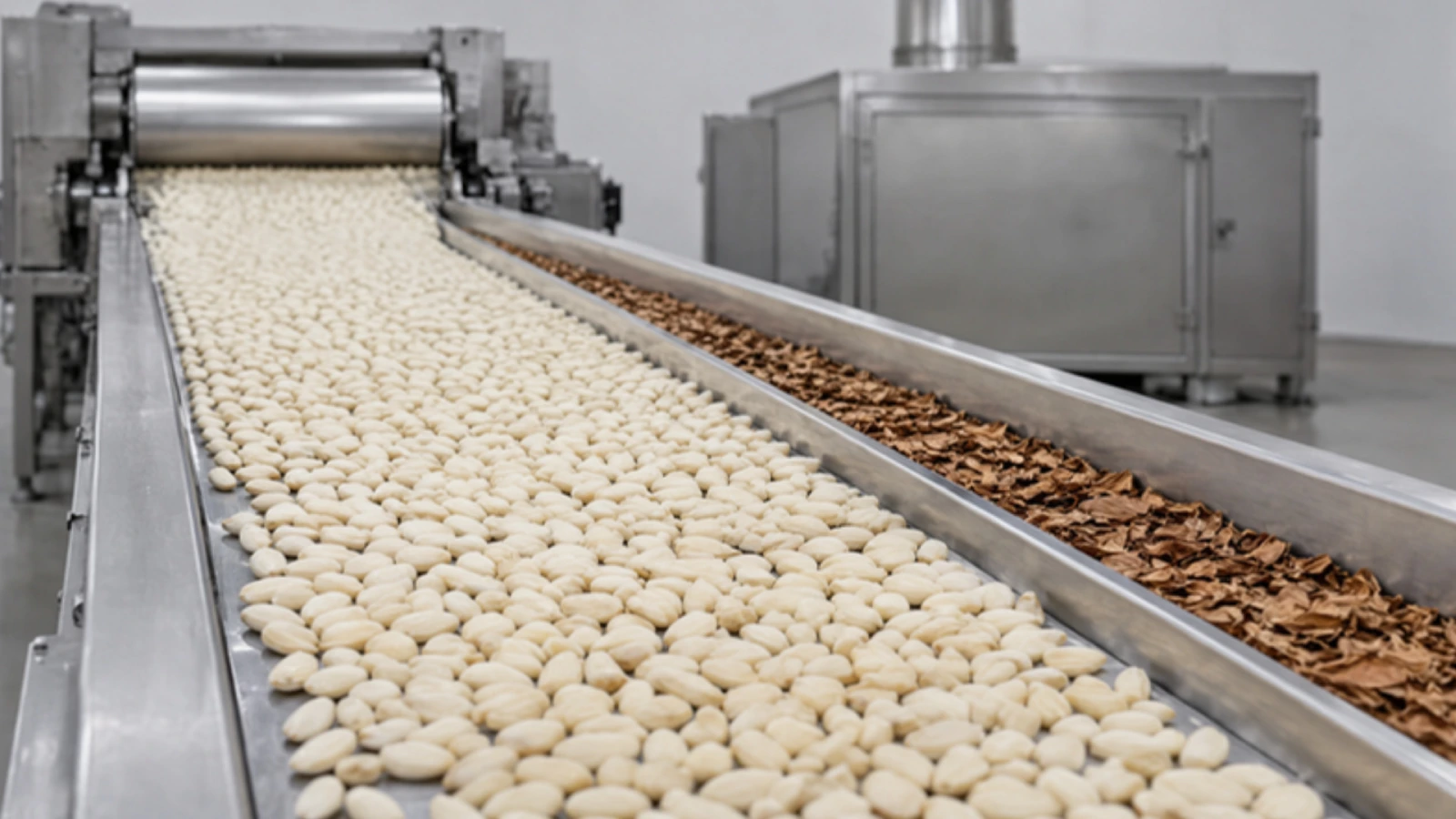

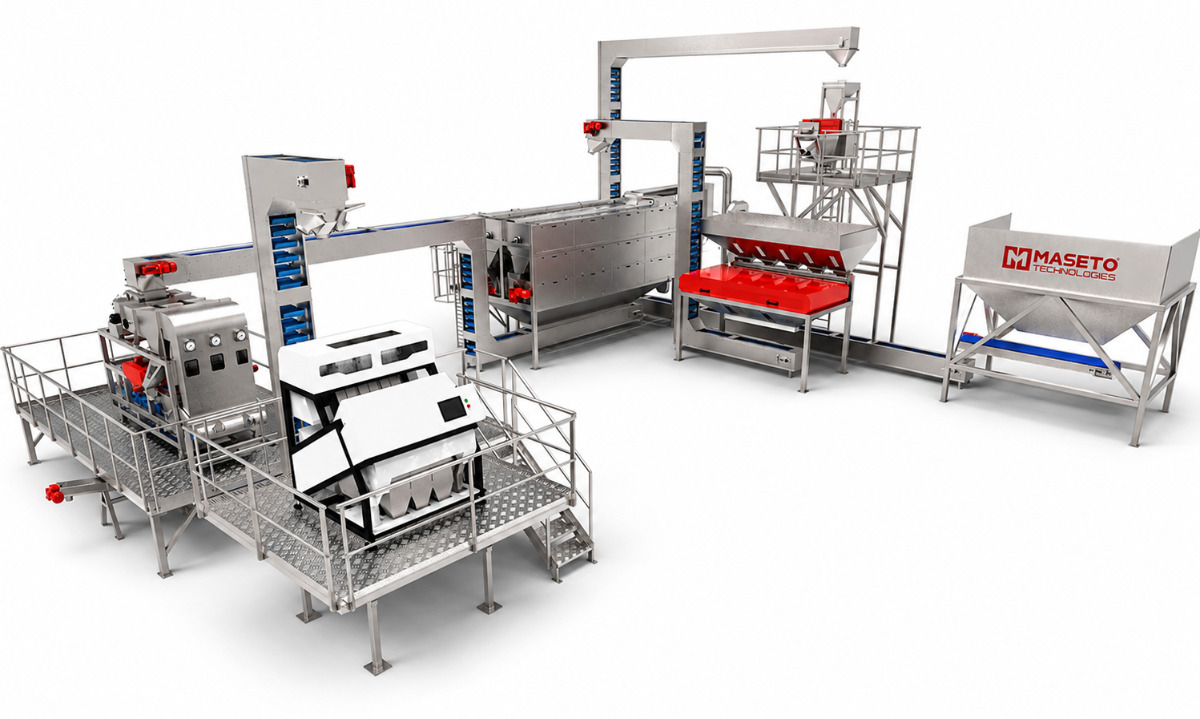
If you are working out how to plan a nut processing plant from scratch, the first thing our team would tell you has little to do with machines. As one of our engineers puts it in a recent reel, “Most of the delays in a new plant aren’t technical. They’re due to poor planning.” After more than six decades designing and building processing lines in Alicante, and with equipment running in 53 countries, we see the same pattern again and again. Projects rarely slip because a sheller or a roaster fails to perform. They slip because a decision that should have been made in month two was left until month eight.
This article sets out what a well-planned project looks like, based on what our team explains in the reel and on the questions plant managers, production directors and purchasing teams ask us when they start a new facility.
Why a new plant is more than a list of machines
“A production line isn’t just about choosing machinery and signing contracts,” our team explains. It is tempting to treat a new plant as a shopping list: a cracker, a shelling unit, a blancher, a dryer, a roaster, an optical sorter, a packing station. Each item gets a quote, each quote gets compared, and the orders go out.
The difficulty is that nut processing is a chain. The capacity of a pasteuriser has to match what the cleaning and washing section can deliver. The moisture content leaving the dryer determines how the roaster behaves. Conveying and storage between stages decide whether the line runs continuously or stops every time one machine catches up with another. A plant processing almonds faces different questions from one handling pistachios, hazelnuts or sesame, and a facility that plans to process several products needs those differences built into the layout from day one.
That is why we approach projects as complete nut processing lines rather than as separate pieces of equipment. The machines matter, but the way they connect matters just as much.
Everything has to fit together before the campaign starts
Nut processing is seasonal. Raw product arrives after harvest, and the plant has to be ready to receive it. Our team is clear on this point: “Everything has to fit together from the start of the campaign.”
In practice, this means the project calendar works backwards from the first day of intake. Building works, utilities, electrical supply, compressed air, water for washing and blanching, ventilation for roasting areas, foundations for heavy equipment: all of this has to be ready before installation, and installation has to be finished before commissioning. Commissioning, in turn, needs enough time for trials with real product, operator training and adjustments.
When planning starts late, the campaign date does not move. Something else has to give. Here is a rough sequence of the decisions a new plant needs to settle early:
- Which products will be processed, at what volumes, and in which final formats (whole, blanched, sliced, diced, roasted, salted, paste).
- Target capacity per hour and per campaign, including room to grow.
- Plant layout and product flow, from raw material reception to finished goods storage.
- Food safety requirements, including whether pasteurisation is needed for the markets you sell into.
- Utilities, civil works and building constraints.
- Installation, commissioning and training schedule tied to the harvest date.
None of these is unusual. What causes trouble is answering them in the wrong order, or answering one without considering the others.
The real cost of late decisions
“When a decision comes too late, it forces you to cut corners exactly where you shouldn’t.” This is perhaps the most important point in the reel, and it matches what we see on site.
Cutting corners rarely looks dramatic at the time. It might be a shorter commissioning period because the harvest is already arriving. It might be a conveying solution chosen because it fits the space left over, not because it suits the product. It might be a dryer sized to the budget remaining instead of the moisture load it will face. Each choice seems reasonable under pressure. Together, they produce a plant that never quite reaches its design capacity, or one that needs modifications in its second year.
For a production director, the consequence is daily: bottlenecks, extra handling, more product damage, higher energy use. For a finance director, it shows up as a return on investment that takes longer than expected. In both cases, the root cause sits months earlier, in a planning meeting where a decision was postponed.
What to ask before you sign
Our team has a message they repeat to finance directors when comparing offers for a new line: “Ask what’s included, how it will operate, and who’s responsible if something goes wrong.”
These three questions are worth unpacking, because two quotes that look similar on paper can describe very different projects.
What is included
Does the offer cover engineering and layout design, or only the equipment? Are conveyors, elevators, buffer hoppers and storage part of the scope? Is installation included, and commissioning with real product? Is operator training part of the package? A lower figure often reflects a narrower scope, and the missing parts still have to be bought, coordinated and installed by someone.
How it will operate
Ask for the expected capacity with your product, at your moisture levels and calibres, not with a generic reference. Ask how the line handles changeovers if you process more than one nut or seed. Ask about cleaning access, maintenance intervals and wear parts. A supplier who has worked with almonds, pistachios, hazelnuts, peanuts, walnuts, macadamias, cashews, pine nuts and sesame should be able to answer these questions in concrete terms.
Who is responsible if something goes wrong
When several suppliers provide different sections of a line, a problem at the interface between two machines can become nobody’s problem. Clear responsibility, from design through to after-sales technical service, reduces that risk. This is one of the reasons many of our clients prefer a single partner for engineering, manufacturing, installation and commissioning. You can see the range of equipment we design and build on our nut and seed processing machines page.
Frequently asked questions
How far in advance should we start planning a new nut processing plant?
As early as possible. Our team’s advice is simple: “An industrial investment needs to be planned well in advance.” The exact lead time depends on the scope, the civil works involved and the equipment required, so the best starting point is a conversation about your products, volumes and target campaign.
Can we plan for future expansion from the start?
Yes, and it is far easier to do it at the design stage. Leaving space in the layout, sizing utilities with margin and choosing equipment that allows additional modules later avoids costly rework when demand grows.
Do we need a complete line or can we add machines to an existing plant?
Both are possible. Many clients come to us to add, replace or expand specific sections. The same planning principles apply: any new machine has to fit the capacity and flow of what is already running.
Does a single supplier for the whole line really make a difference?
It simplifies coordination and makes responsibility clear. With one partner handling engineering, manufacturing, installation and after-sales service, questions about performance at any point in the line have a single point of contact.
The final words of the reel sum up the approach: “Rushing is what costs you.” Watch the full reel to hear our team explain it in their own words, and if you are preparing a new plant or expanding an existing one, contact our team to start planning your line with the time it deserves.