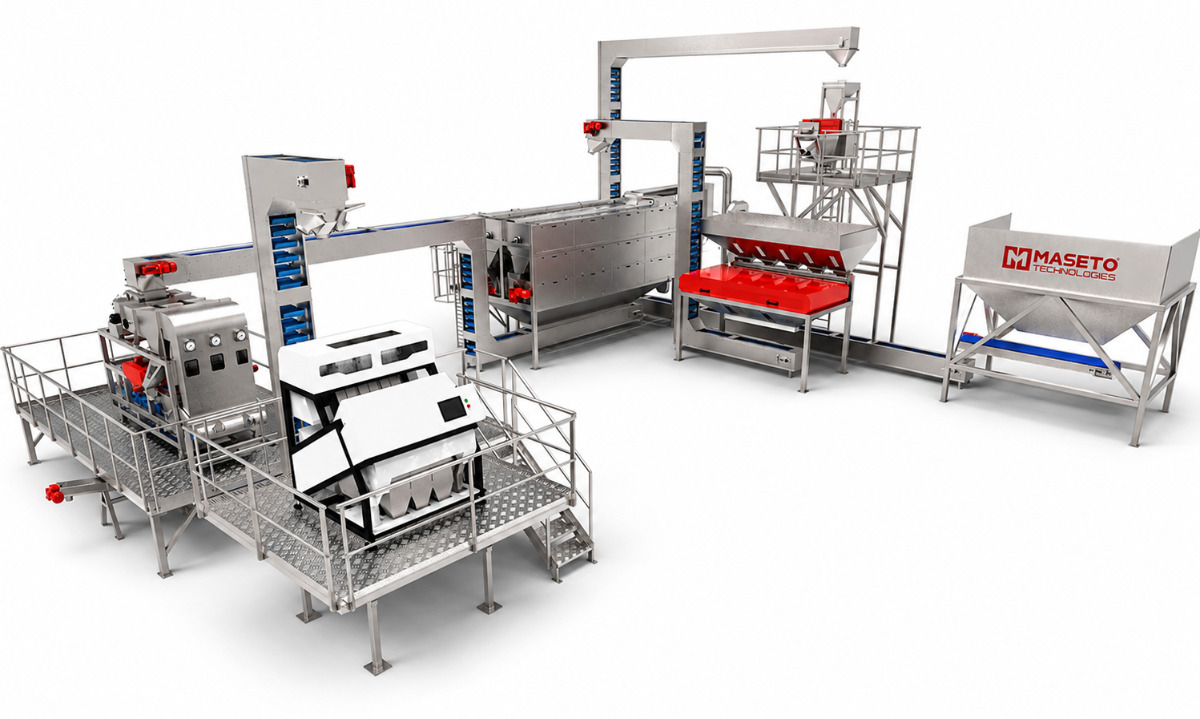

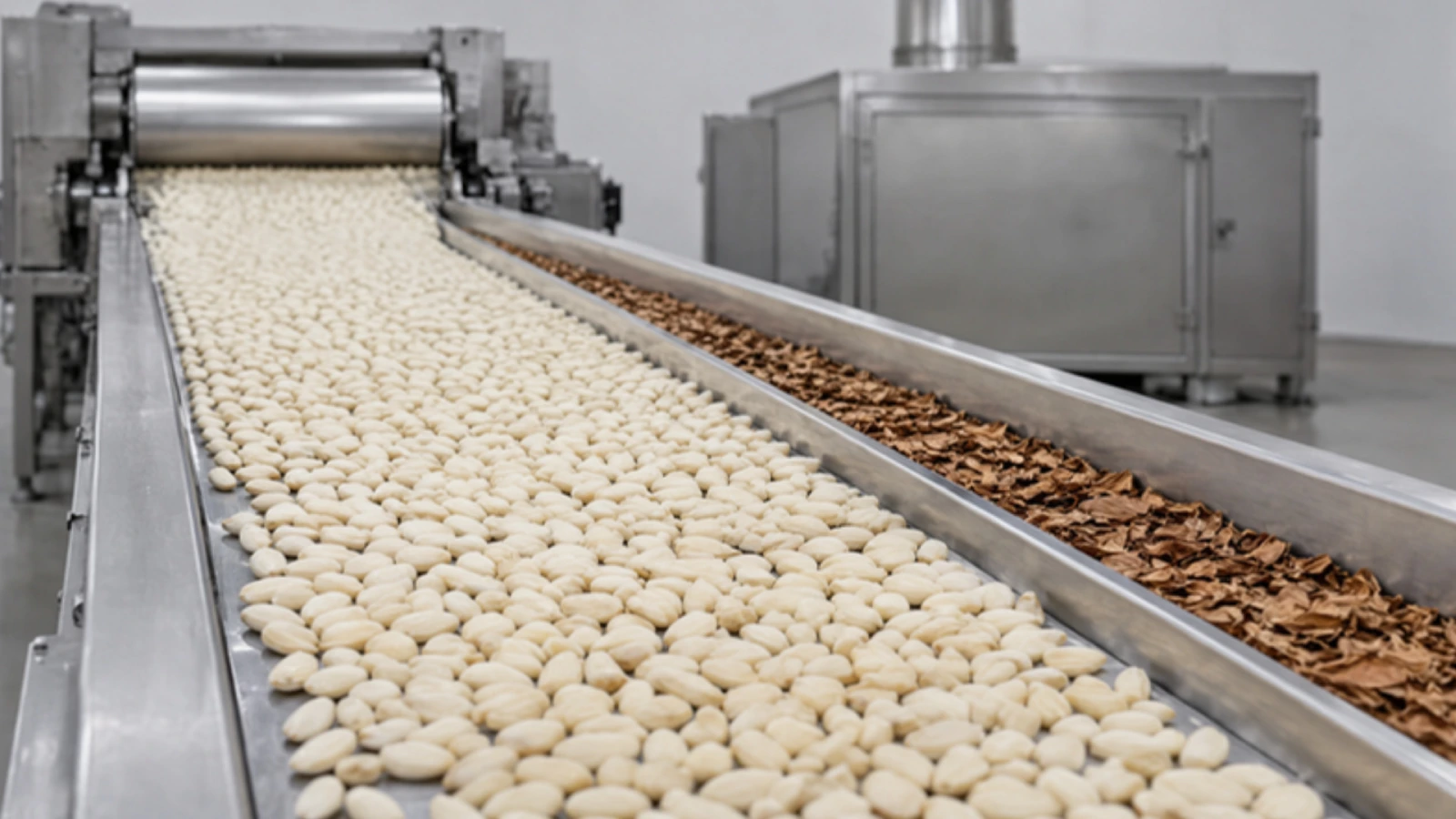
An almond blanching and peeling line for export is a sequence of equipment, not a single machine. It takes shelled almonds, loosens and removes the brown skin, dries the white kernels to a stable condition and delivers a product that meets the specification of a buyer in another country. If you are a processor planning to add blanched almonds to your range, or replacing an older installation that no longer meets your customers’ requirements, this guide explains how the line is built and which stages carry the most weight when the product is shipped abroad. It also covers the points to settle with the manufacturer before you sign an order.
What an almond peeling line has to achieve
Blanched almonds are an ingredient. They go into marzipan, nougat, almond flour, dragées, bakery fillings, snack mixes and plant-based drinks. Each of those uses sets its own tolerances, and an export customer will usually send a specification sheet before the first container is agreed. That document defines what your line has to produce day after day.
In practical terms, the line must remove the skin cleanly without breaking or scarring the kernel, keep the almonds free from contamination after the skin has gone, and bring moisture back down so the product stays stable during storage and transport. A plant that sells locally can sometimes tolerate variation from batch to batch. A plant that ships to a food manufacturer on another continent generally cannot, because a rejected lot means freight, storage and a damaged relationship.
Process stages in a blanched almond processing line
Every installation is adapted to the raw material, the target product and the space available, but most lines follow a similar order.
Reception, cleaning and calibrating
Shelled almonds arrive with dust, pieces of shell, stones and other foreign matter. Cleaning and screening before blanching protects the downstream machines and avoids carrying impurities into the water. Calibrating by size at this point also helps, because kernels of similar size respond more evenly to heat and peeling. Mixed sizes are one of the most common causes of irregular results in the peeler.
Blanching
The almonds are exposed to hot water or steam for a controlled time so that the skin separates from the kernel. Too little treatment leaves skin attached. Too much softens the almond, affects texture and colour, and increases breakage later. The right setting depends on the variety, the crop year and how long the almonds have been stored, so the blancher needs precise and repeatable control of temperature and residence time.
Peeling and re-peeling
Once the skin has loosened, the kernels pass through the peeling machine, where rollers rub the skin away. Skins are separated and removed from the product stream. A well-designed line includes a re-peeling stage, or a return circuit, so that almonds that still carry skin get a second pass instead of being downgraded. This is where much of the yield of the line is won or lost.
Drying and cooling
After peeling, the almonds have absorbed water and must be dried before they can be stored or packed. Drying has to be uniform. Kernels that remain damp inside the bulk can develop mould or rancidity during a long sea voyage, while over-drying causes cracking. The product is then cooled to ambient temperature so that condensation does not form inside the packaging.
Further processing
Many processors add value after blanching by cutting the almonds into slices, slivers, dice or flour grades, or by roasting and salting them. Planning these steps at the design stage is far easier than adding them later, because the transport, buffer storage and floor layout have to accommodate them. You can see the range of individual nut and seed processing machines that can be combined in a complete line.
What export buyers look for in blanched almonds
Requirements vary between markets and between customers, so the first step is always to read the specification you are working to. The questions that come up most often from buyers are these.
- Microbiological safety. Blanched almonds are frequently used in products that are not cooked again, so buyers pay close attention to pathogens. Some markets require almonds to be pasteurised, as is the case in the United States, and many food manufacturers ask for a validated pasteurisation step regardless of origin. The blanching treatment itself can contribute to this, but whether it counts as a validated kill step depends on how the process is designed, controlled and documented.
- Skin residue. Specifications usually limit the amount of skin left on kernels, and colour is checked visually or with optical equipment.
- Broken and damaged kernels. Whole blanched almonds command a better price than splits and pieces, so mechanical handling that minimises breakage has direct commercial value.
- Moisture content, which affects shelf life and behaviour in the customer’s own process.
- Foreign material and traceability. Buyers expect lot identification and records that link each shipment to the conditions under which it was produced.
Equipment cannot replace a food safety management system, but it can make compliance much easier. Hygienic design, stainless steel contact surfaces, access for cleaning and accurate process control all reduce the effort needed to prove that every lot was produced under the same conditions.
Sizing an almond blanching line for your plant
The capacity question is rarely as simple as kilos per hour. A processor in California handling Nonpareil, a cooperative in Spain working with Marcona and Largueta, and a plant in Turkey or Iran processing local varieties will all face different skin adherence, kernel shape and fragility. Varieties that peel easily allow different settings from those that hold their skin tightly, and the line should be designed around the raw material you actually process.
Before requesting a proposal, it helps to have answers to the following:
- Which varieties and calibres you process, and how the mix changes through the year.
- What the final products are: whole blanched, sliced, slivered, diced, flour, roasted.
- The hours per shift and shifts per day you intend to run.
- Available floor space and ceiling height, and whether the line goes into an existing building.
- Utilities: water quality and supply, steam or heating source, electrical capacity and treatment of wastewater.
- Which steps already exist in your plant and which must be supplied new.
With this information an engineering team can propose a layout that balances each stage so that no single machine becomes a bottleneck. If you are starting from an empty site rather than extending an existing facility, our earlier article on how to plan a nut processing plant from scratch covers the wider decisions.
Return on investment and long-term reliability
Blanched almonds sell at a premium over natural kernels, and the margin depends on how much of the incoming product leaves the line as whole, clean, first-grade kernels. A line that peels consistently on the first pass, recovers kernels through re-peeling and handles them gently will deliver more saleable product from the same raw material. Automation also reduces the labour needed for manual inspection and rework.
For processors far from the manufacturer, reliability and service matter as much as the purchase price. Ask how spare parts are supplied to your country, whether technicians can support you remotely, and who will handle installation, commissioning and operator training. A line that stops during the harvest peak because a part is weeks away is expensive, however competitive the initial quote.
Maseto has designed and built nut and seed processing equipment in Alicante since 1960, and its machines are installed in 53 countries. Projects cover engineering, manufacturing, installation, commissioning and after-sales technical service, which means a single team is responsible for the line from the first drawing to production. You can read more about Maseto and its experience with almonds, pistachios, hazelnuts and other kernels.
Frequently asked questions
Can the same line process other nuts as well as almonds?
Some stages, such as cleaning, calibrating, drying, roasting and transport, can be shared with other products. Blanching and peeling settings are specific to each nut, so if you plan to run peanuts or hazelnuts on the same equipment, this should be defined during the design phase.
Is blanching enough to meet pasteurisation requirements?
Not automatically. The treatment must be validated for the target reduction required by your market or customer, and the parameters must be monitored and recorded. Discuss your export destinations with the manufacturer so the process can be designed accordingly.
Can new equipment be integrated into an existing plant?
Yes. Many projects add blanching and peeling to a facility that already cleans and sorts almonds, or replace a single stage that limits output. A site survey and a review of your current flow are the usual starting point.
If you are planning to produce blanched almonds for international customers, send us your varieties, target products and expected volumes, and our engineers will prepare a proposal for a line built around your raw material and your buyers’ specifications. Visit our nut processing lines or contact our team to arrange an initial technical consultation.