
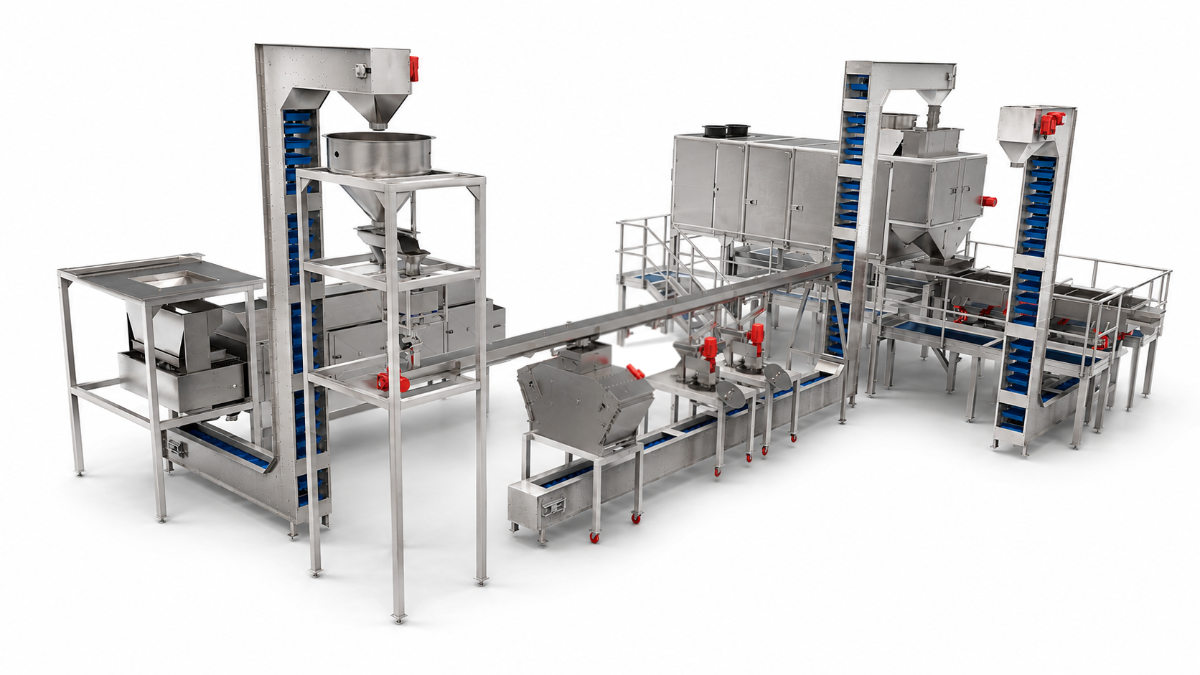
Nut production lines should not be seen simply as a sequence of machines. In an industrial plant, true performance depends on how all stages of the process interact, how the product moves between them and how closely the installation is adapted to real production requirements.
Shelling, peeling, sorting, cutting, drying, roasting, cooling, conveying and storage are all different operations, but they form part of the same system. Maseto develops solutions for all these stages of processing, from shelling through to final storage and handling.
For this reason, designing an industrial line involves much more than selecting machinery with a certain capacity in kilograms per hour.
Every production line should start with the product
Before defining the machinery, it is essential to understand what is going to be processed.
Not all raw materials behave in the same way. The type of nut, variety, size, moisture content and desired final product all influence how the installation should be configured.
A line designed to process almonds may require different stages and settings from one intended for pistachios, hazelnuts or other products.
The same applies within a single raw material: changing variety or size can alter the way the product behaves during shelling, peeling or cutting.
That is why line design should begin with an analysis of the actual product and the real operating conditions.
The capacity of one machine is not the capacity of the entire plant
One of the most common mistakes when assessing an industrial investment is to analyse each piece of equipment in isolation.
A machine may offer a high nominal capacity and still fail to improve overall performance if the previous stage cannot feed it correctly or the next stage cannot handle the incoming product.
This is where bottlenecks appear.
A properly dimensioned line should maintain balance between all stages in order to achieve a stable production flow.
Efficiency does not depend on which machine is the fastest, but on how the entire system performs.
What processes can a nut production line include?
The configuration will depend on the product and the required final result, but a line may include a wide range of operations.
Maseto develops machinery for processes including:
- shelling;
- cleaning and washing;
- pasteurisation;
- peeling and blanching;
- screening and sorting;
- cutting;
- chopping and refining;
- drying;
- roasting and salting;
- cooling;
- conveying;;
- storage and handling.
The key is not simply to have access to each technology, but to integrate them correctly within the plant.
Line design has a direct impact on performance
Each stage changes the conditions in which the product reaches the next.
Poor sizing can affect shelling. An overly aggressive treatment can increase breakage. Irregular feeding can reduce consistency in a subsequent process.
For this reason, what may seem like a minor design decision can ultimately affect the economic performance of the entire installation.
In a high-capacity plant, even small differences in product yield can represent significant volumes over months or years.
The design should therefore aim not only for capacity, but also for quality, stability and maximum use of the raw material.
Production lines designed to evolve with the plant
An industrial plant does not always operate under the same conditions.
Harvests, volumes, varieties, products and commercial requirements all change over time.
That is why versatility is an important characteristic of a production line.
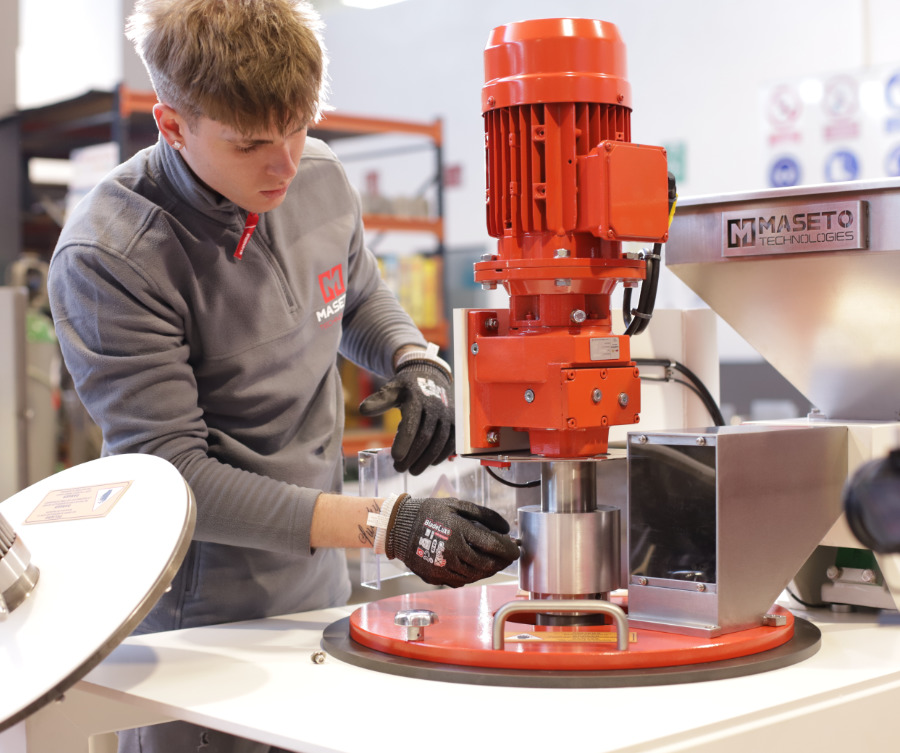
Maseto identifies high durability, versatility, easy maintenance and stainless-steel construction among the key features of its equipment.
Designing solely around today’s requirements can limit the installation a few years later.
A well-planned line should also take into account the capacity the company may need in the future and how its production process could evolve.
Custom-built systems versus standard solutions
Not every plant requires the same configuration.
One company may need a completely new line. Another may need to integrate additional machinery into an existing installation. A third may be primarily focused on removing a bottleneck or improving a specific stage.
For this reason, Maseto works with a customised manufacturing approach.
The company specialises in the design and manufacture of industrial machinery for nut and sesame processing and identifies component quality as one of its key differentiating factors.
The aim is for the machinery to adapt to the project, rather than forcing the customer to reorganise the entire production process around a standard solution.
An industrial line is designed to operate for years
The purchase of industrial machinery cannot be assessed solely on the basis of its initial cost.
These are systems that need to remain operational for many years.
The investment should therefore be evaluated by considering factors such as:
- productivity;;
- maintenance;
- service life;
- pérdidas de materia prima;
raw material losses;- ease of adjustment;
- process continuity;
potential for future expansion.
Maseto highlights durability, production precision and low maintenance requirements as central aspects in the development of its equipment.
An industrial solution should generate value throughout its entire service life.
Service does not end once the line is installed
Plant performance does not depend solely on the initial design either.
Commissioning, adjustments and ongoing support are essential to ensure that the installation operates under the conditions for which it was designed.
Maseto considers after-sales service an essential part of its approach and emphasises that its work continues after installation to help customers obtain the maximum return from their investment.
For installations designed to operate for many years, this continuity is particularly important.
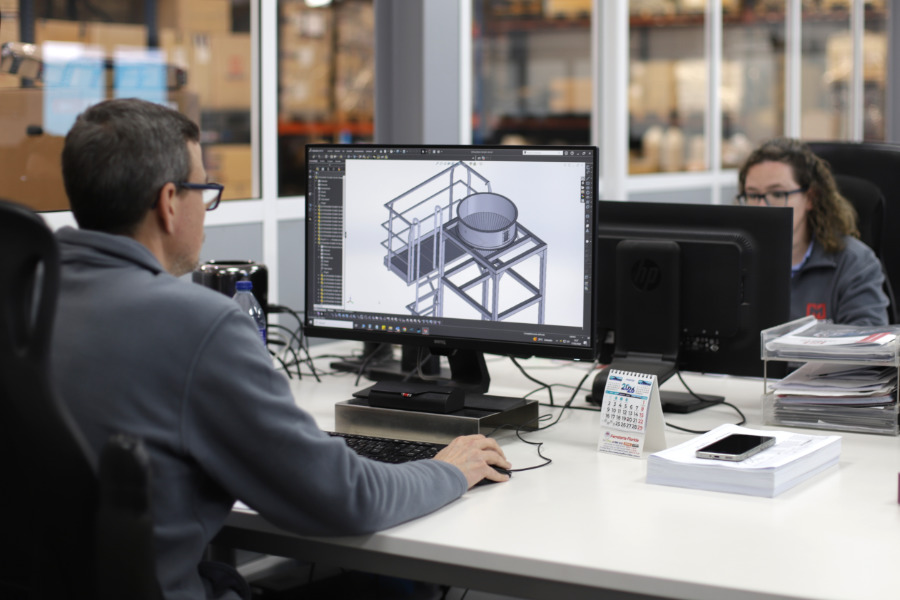
Designing a production line means designing a complete process
An efficient industrial line is not created by selecting machines one by one.
It starts by understanding:
what product enters the plant;
what final result is required;- what capacity the company needs;
how the product should move through the process;
which losses need to be minimised;
what growth potential the plant should have.
Only then should the technology be defined.
At Maseto Technologies, experience in nut and sesame processing machinery is combined with an approach based on research, development and continuous improvement to adapt each solution to the needs of the individual installation.
Because a good nut production line is not simply one that includes good machines.
It is one in which every machine works as part of a single system to protect the product, maintain quality and improve plant profitability.