

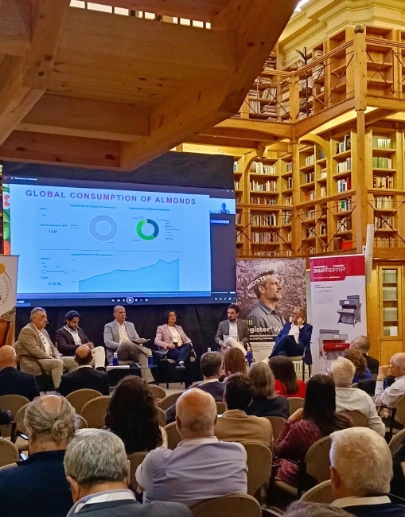
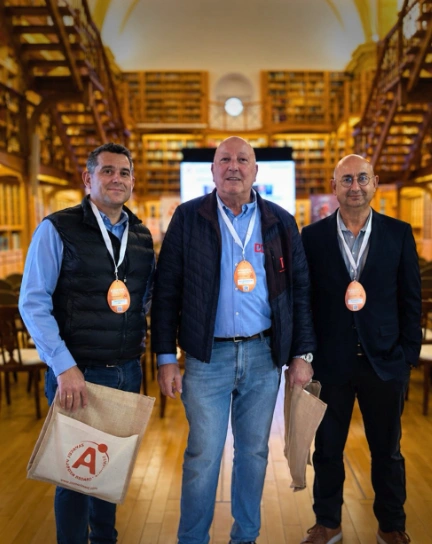
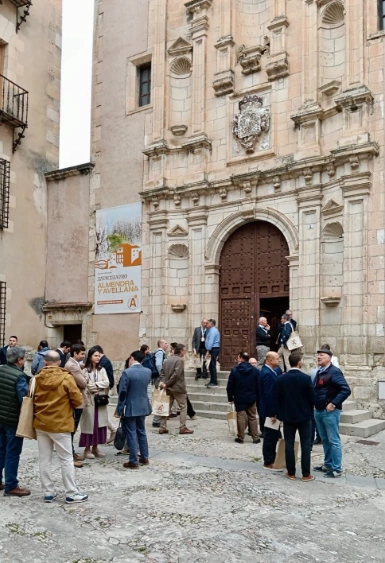
Maseto Technologies took part in the 11th Almond and Hazelnut Meeting, organised by SAB-Almendrave and held on 29 April 2026 at the Hospedería del Seminario in Cuenca.
The event brought together around 170 professionals from across the entire industry value chain, from production through to marketing and distribution, for a day focused on analysing the evolution of the sector, new production challenges and current market conditions.
For Maseto, attending events of this kind provides an opportunity to remain closely connected to the realities of the almond industry and gain first-hand insight into how both the raw material and the needs of processing companies are evolving.
An established event for the almond and hazelnut industry
The Almond and Hazelnut Meeting has become one of the leading events for the Spanish industry.
Organised by SAB-Almendrave, the Spanish Almond and Hazelnut Exporters Association, the event brings together operators, institutional representatives and companies from across the industry each year, with the aim of encouraging dialogue, creating value and discussing the main challenges facing both products.
After previous editions in cities including Alicante, Córdoba, Almería, Reus, Murcia, Madrid, Albacete, Badajoz and Valencia, Cuenca hosted the eleventh edition in 2026.
Events of this kind are particularly relevant in an industry where decisions made at farm level, the development of new varieties and changes in the market ultimately have a direct impact on downstream industrial processes.
A sector undergoing significant change
One of the key messages to emerge from the event was the period of transformation currently affecting the Spanish almond and hazelnut industry.
The discussions covered issues including the expansion of cultivated areas, developments in international markets and the new challenges associated with competitiveness, consumption and sustainability.
The programme also examined production and consumption from a range of perspectives, including profitability, market conditions, sustainability and health.
All of these factors have direct consequences for the processing industry.
As production changes, new varieties emerge or the availability of raw materials increases, processing plants need to be able to absorb these changes while maintaining productivity, quality and profitability.
A record harvest forecast for Spanish almonds
One of the most significant figures presented during this year’s event was the forecast for the 2026 season.
According to the preliminary forecast published by Almendrave, Spanish production could reach 146,000 tonnes of almond kernels, provided weather conditions remained favourable.
Greater product availability represents an opportunity for the sector, but it also creates new demands for processing companies.
As volumes increase, it becomes even more important to have processing lines capable of maintaining a continuous flow, adapting to different product characteristics and reducing losses at every stage.
The challenge is not simply to process greater volumes, but to ensure that increased production also retains its commercial value.
Higher production also requires greater adaptability
Almonds are not a uniform raw material.
Different varieties, sizes and moisture levels can behave differently during processes such as shelling, peeling, sorting or cutting.
For this reason, an increase in production should not simply lead to a search for greater nominal capacity.
It also requires processing lines capable of adapting to an increasingly diverse raw material.
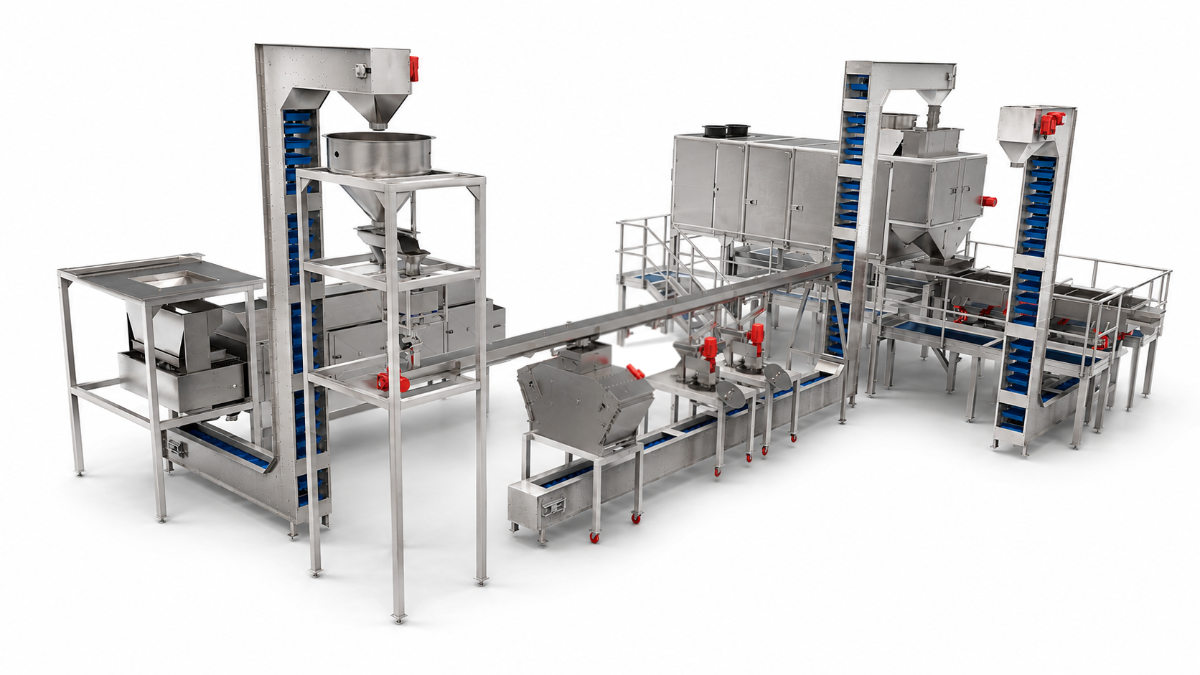
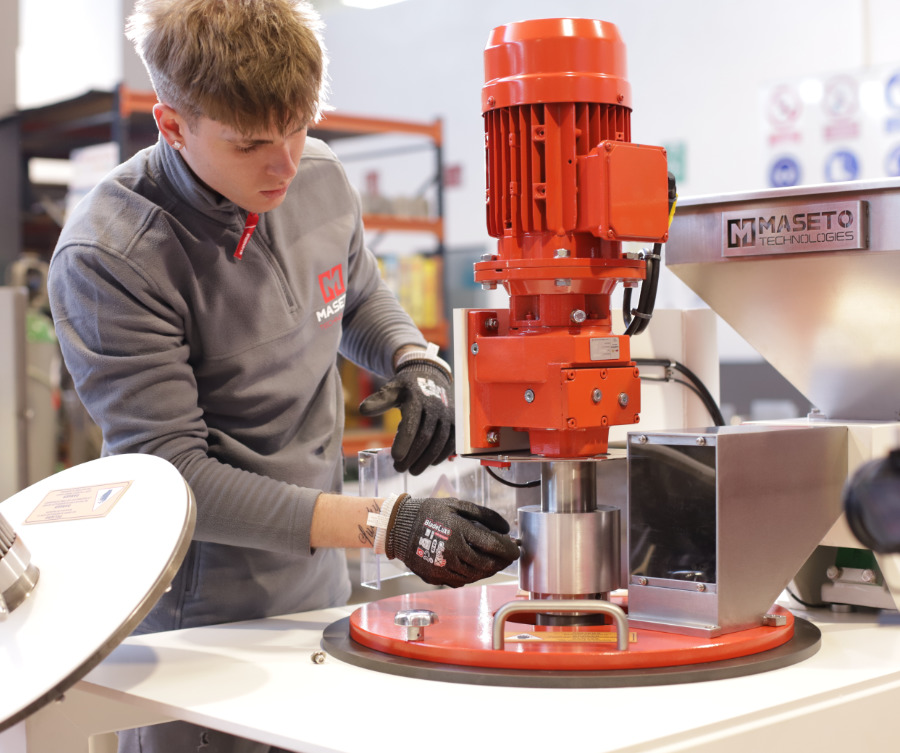
For Maseto, this in-depth understanding of the product forms part of the design of every installation. The company develops machinery and complete lines for processes including shelling, peeling, cutting, sorting, roasting, drying, cleaning and storage, with an approach based on customised manufacturing and optimised product handling.
Profitability and competitiveness: two closely linked challenges
Competitiveness was another of the central themes discussed during the meeting.
In an industry facing growing international pressure, improving productivity is not simply a matter of increasing machine speed.
The profitability of a processing plant also depends on factors such as:
- maximising raw material yield;
- reducing product damage;
- maintaining process consistency;
- energy consumption;
- ease of maintenance;
- production continuity;
and the ability to handle different varieties and sizes.
A poorly balanced installation may increase capacity at one stage of the line while creating a bottleneck at the next.
Efficiency therefore needs to be assessed across the entire process.
Sustainability and industrial efficiency
Sustainability was another of the topics addressed at the Cuenca meeting.
For several years, SAB-Almendrave has been developing initiatives aimed at strengthening the positioning of Iberian almonds around aspects such as sustainability, traceability, quality and their connection with the regions where they are produced.
From an industrial perspective, sustainability also means making better use of resources.
Reducing product losses, avoiding unnecessary reprocessing, optimising consumption and extending the service life of machinery not only improve profitability, but also make the overall production process more efficient.
For a machinery manufacturer such as Maseto, this evolution means continuing to develop solutions capable of meeting both production requirements and the industry’s growing efficiency objectives.
Staying close to the industry to design better solutions
Maseto’s participation in the 11th Almond and Hazelnut Meeting reflects a fundamental principle: to develop effective industrial solutions, it is essential to understand how the industry itself is evolving.
Changes in production, varieties, markets and commercial requirements will inevitably reach processing plants.
Taking part in forums where producers, processors, traders and technology companies exchange experience makes it possible to identify emerging needs before they become operational problems within a facility.
For Maseto, this close connection with the industry complements the engineering and development work the company has carried out for decades in the nut processing sector.
Changes in the industry are also transforming almond processing
The Cuenca edition once again highlighted an industry with significant opportunities for growth, but also with new challenges ahead.
A strong harvest forecast, evolving international markets, increasing sustainability requirements and growing competition are forcing processing companies to review the way they operate on an ongoing basis.
Technology has a key role to play in this process.
A well-designed processing line must be able to protect the product, preserve quality, make better use of the raw material and adapt to different production scenarios.
This is precisely why events such as the Almendrave meeting are relevant for Maseto.
They provide an opportunity to continue listening to the industry, sharing knowledge and developing solutions for an almond sector that is becoming increasingly efficient, competitive and better prepared for the years ahead.